Security Aspects of Hiking
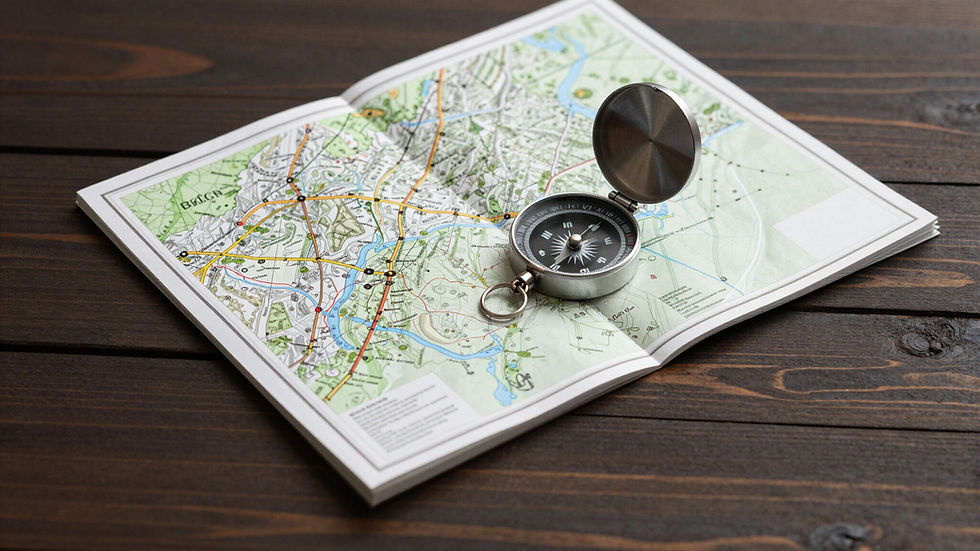
1. Navigation: Topographic map and compass
Batteries die, but gravity and Earth's magnetism are eternal. Knowing how to use this duo is the foundation of self-reliance in the forest.
The topographic map: It represents the terrain in 3D on a flat sheet using contour lines. The closer together the lines are, the steeper the slope. If they form concentric circles, you are looking at a summit.
The compass: The golden rule is to align the magnetic needle (magnetic north, often red) with the orienting arrow etched into the compass housing. This is commonly referred to as "putting the red in the shed."
Magnetic declination: This is a classic pitfall. True north (the top of the map) and magnetic north (where the needle points) are not in the same place. Depending on your region, there is a difference of several degrees that must be adjusted on your compass dial to avoid drifting off course over long distances.
2. The best GPS apps (and how to use them)
Modern apps offer incredible precision—provided you download offline maps before losing cellular service.
AllTrails: The most popular app for discovering trails. Ideal for checking recent hiker reviews on trail conditions, though less robust for complex off-trail navigation.
Ondago / Avenza Maps: Widely used in Quebec. They allow you to download official PDF maps for regional parks or SÉPAQ areas and view your real-time GPS position (as a blue dot), even without a network connection.
Gaia GPS / OnX Backcountry: Tools for professionals and off-trail enthusiasts. They offer ultra-detailed topographic map layers, data on public versus private land, and advanced route-tracking tools.
💡 Golden rule for battery life: When hiking, keep your phone in airplane mode to save power, and always carry a portable charger (power bank) in your pack.
3. The essential first aid kit
A good kit doesn't have to be heavy, but it must address the real risks associated with hiking: blisters, cuts, sprains, and allergies.
Essentials for your pack:
Foot care: Moleskin or hydrocolloid bandages (like Compeed) to stop blisters at the first sign of chafing.
Minor injuries: Elastic bandages (like Tensor wraps) to stabilize a sprained ankle, heavy-duty medical tape (duct tape), and sterile gauze pads.
Medications: Pain relievers (ibuprofen/acetaminophen), an antihistamine (Benadryl for reactions to stings or plants), and your personal medications.
Survival tools: Tweezers (essential for ticks and splinters), antiseptic wipes, and an emergency thermal blanket (weighing just a few grams).
4. Wildlife Encounters: Best Practices.
Wild animals generally try to avoid you. The key is never to startle or corner them.
Black Bear (the most common species in Quebec/Eastern Canada).
While hiking: Make noise. Talk, sing, or clap your hands—especially near waterways or in windy weather—to signal your presence.
In a face-to-face encounter: Stop and stay calm. Do not run (this would trigger its predatory instinct). Speak in a calm, low voice and back away slowly without turning your back on the animal. If it approaches, make yourself look larger by raising your arms.
The ultimate defense: Always keep bear spray accessible on your belt or backpack strap; never bury it at the bottom of your pack.
Moose (often more dangerous than people realize).
A moose is not just a harmless, oversized deer; an adult male can weigh over 500 kg. They are unpredictable, especially in the autumn (mating season) or spring (mothers with calves).
In a face-to-face encounter: Unlike the bear, the moose is not a predator. If it approaches or shows signs of agitation (ears pinned back, hackles raised), back away and put a large obstacle—such as a large tree or a rock—between you and the animal. If it charges, run to take cover behind that obstacle.

Commentaires